chem lab manual

chem lab manual
This manual serves as a dependable guide for operating and maintaining your chemistry experiments with confidence. It’s curriculum-based, featuring unit-wise experiments,
aims, theories, and expected results.
Purpose of a Lab Manual
A chemistry lab manual’s core purpose is to provide a structured approach to practical learning. It details experiments, outlining aims, required materials, and expected outcomes. This resource bridges theoretical knowledge with hands-on application, fostering a deeper understanding of chemical principles.
Furthermore, it ensures student safety by detailing proper procedures and protocols. The manual acts as a reliable companion, enhancing confidence and skill development throughout the learning process, aligning with curriculum standards.
Importance of Safety in the Chemistry Lab
Safety is paramount within the chemistry lab environment. A lab manual emphasizes this through detailed protocols and the necessity of Personal Protective Equipment (PPE). Understanding potential hazards – chemical handling, equipment operation – is crucial.
Proper procedures minimize risks, preventing spills, accidents, and exposure to harmful substances. Adhering to these guidelines ensures a secure learning space, fostering responsible experimentation and protecting both students and the environment.
Essential Lab Equipment and Apparatus
A well-equipped lab includes basic glassware – beakers, flasks, cylinders – alongside heating tools like Bunsen burners and hot plates, plus precise measuring tools.
Basic Glassware: Beakers, Flasks, and Cylinders
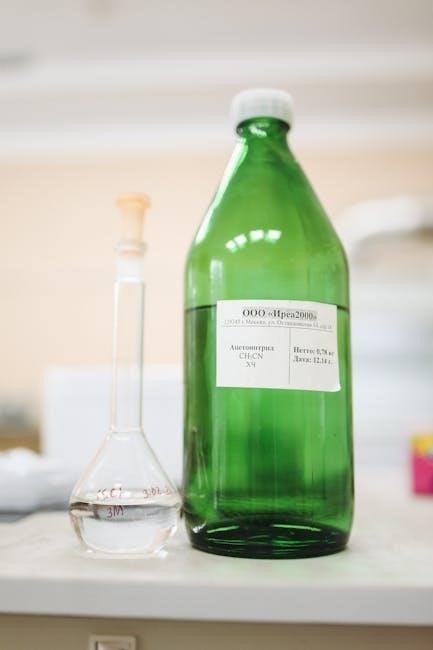
Essential for any chemistry lab, beakers provide a container for mixing, stirring, and heating liquids, though not for precise measurements. Flasks, particularly Erlenmeyer flasks, are ideal for titrations and solutions requiring swirling.
Graduated cylinders offer accurate volume measurements, crucial for quantitative analysis. Understanding the specific uses of each piece of glassware – beakers for general use, flasks for containing, and cylinders for measuring – is fundamental to conducting safe and reliable experiments. Proper handling and cleaning are also vital for maintaining accuracy and preventing contamination.
Heating Equipment: Bunsen Burners and Hot Plates
Heating is a common process in chemistry, and labs utilize Bunsen burners and hot plates. Bunsen burners provide a concentrated, adjustable flame for rapid heating, requiring careful attention to safety protocols. Hot plates offer a more controlled and even heating source, suitable for delicate experiments or prolonged heating. Always use appropriate heat-resistant glassware and be mindful of flammable materials when employing either method. Understanding the advantages and limitations of each heating device is crucial for experimental success.
Measuring Tools: Balances and Pipettes
Accurate measurements are fundamental to chemistry. Balances are essential for determining the mass of substances, requiring proper calibration and technique. Pipettes deliver precise volumes of liquids, available in various types like volumetric and graduated. Careful reading of the meniscus and appropriate pipette selection are vital for accurate results. Mastering these tools ensures reliable data collection and successful experiment outcomes, aligning with curriculum expectations.
Laboratory Safety Protocols
Prioritizing safety is paramount in any chemistry lab. This section details essential protocols, including PPE usage, safe chemical handling, and emergency procedures for spills.
Personal Protective Equipment (PPE)
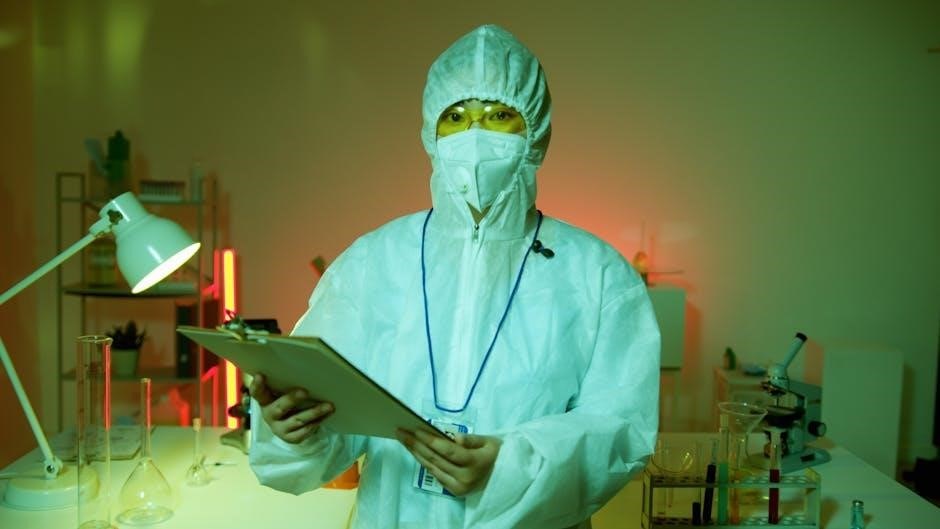
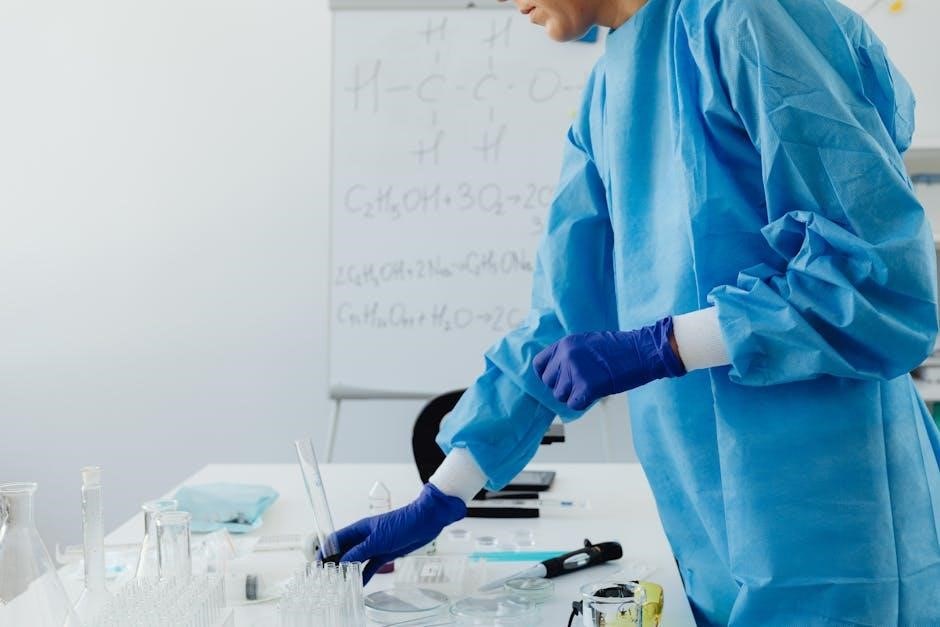
Essential PPE includes safety goggles to protect eyes from chemical splashes, a lab coat to shield clothing and skin, and appropriate gloves to prevent chemical contact. Closed-toe shoes are mandatory; sandals are prohibited.
Understand the specific hazards of each experiment to select the correct glove material. Proper PPE minimizes risks and ensures a safe laboratory environment for all students and researchers. Always inspect PPE for damage before use, and report any issues immediately to your instructor.
Handling Chemicals Safely
Always read and understand the Safety Data Sheet (SDS) before using any chemical. Never smell or taste chemicals. Dispense chemicals carefully to avoid spills, and always add acid to water, never water to acid. Properly label all containers with the chemical name and concentration. Store chemicals according to compatibility guidelines, separating acids from bases and oxidizers from flammables. Dispose of chemical waste in designated containers following established protocols;
Emergency Procedures: Spills and Accidents
In case of a spill, immediately notify the instructor and fellow students. For minor spills, contain the spill with absorbent materials and follow disposal procedures. For larger spills or accidents resulting in injury, activate the emergency alarm and evacuate the lab. Know the location of safety equipment like eyewash stations and safety showers. Report all incidents, no matter how small, to ensure a safe learning environment.

Qualitative Analysis
This section focuses on identifying substances through observation – determining the presence of cations, anions, and recognizing various gases through specific tests.
Identifying Cations
Cation identification involves employing specific chemical reactions to confirm their presence within a solution. These tests often rely on the formation of precipitates, insoluble compounds that visually indicate the cation’s existence. Common methods include utilizing group reagents, systematically separating cations into groups based on solubility differences.
Further testing within each group then pinpoints the specific cation present. Flame tests, observing characteristic colors when heated, are also crucial for certain cations like sodium and potassium. Careful observation and accurate record-keeping are essential for successful identification.
Identifying Anions
Anion identification utilizes reactions that produce observable changes, like gas evolution or precipitate formation. Tests often involve adding specific reagents to the solution containing the unknown anion. For example, carbonates release carbon dioxide upon acid addition, while sulfates form a white precipitate with barium chloride.
Systematic analysis, employing solubility rules and careful observation, is key. Recognizing color changes and noting precipitate characteristics are vital for accurate anion determination in qualitative analysis.
Testing for Gases
Gas identification relies on characteristic properties. Hydrogen gas produces a ‘pop’ sound when ignited, while carbon dioxide extinguishes a burning splint. Ammonia has a pungent odor and turns moist red litmus paper blue. Chlorine’s irritating odor and ability to bleach damp litmus paper are also key indicators.
These tests require careful observation and understanding of each gas’s unique chemical behavior for accurate qualitative analysis within the chemistry lab.
Quantitative Analysis
This section details methods like titration and gravimetric analysis, alongside dilution calculations, enabling precise determination of substance quantities in chemical experiments.
Volumetric Analysis: Titration
Titration is a core quantitative technique used to determine the concentration of a substance by reacting it with a solution of known concentration. This process involves carefully adding the titrant from a burette to the analyte until the reaction reaches completion, indicated by an endpoint.
Precise measurements of volumes are crucial for accurate results. Students will learn to perform various types of titrations, including acid-base, redox, and complexometric titrations, understanding the underlying chemical principles and calculations involved in determining unknown concentrations.
Gravimetric Analysis
Gravimetric analysis determines the amount of a substance by measuring the mass of a product with a known chemical composition. This technique relies on converting the analyte into an insoluble precipitate, which is then filtered, washed, dried, and weighed.
Accuracy hinges on complete precipitation and purity of the final product. Students will master techniques for preparing precipitates, utilizing filtration apparatus, and performing precise weighing, gaining a strong foundation in quantitative chemical analysis.
Dilution Calculations
Dilution calculations are fundamental in chemistry, involving decreasing a solution’s concentration by adding more solvent. This manual provides a clear understanding of the dilution equation: M1V1 = M2V2, where M represents molarity and V represents volume.
Students will practice applying this equation to determine the volumes needed for preparing solutions of specific concentrations, a crucial skill for accurate experimentation and quantitative analysis in the lab.
Common Chemical Reactions
This section details key reaction types – acid-base, redox, and precipitation – mirroring procedures used in research labs, enhancing practical understanding and experimental skills.
Acid-Base Reactions
Acid-base reactions, fundamental to chemistry, involve the transfer of protons. This manual guides students through experiments exploring neutralization, pH determination, and titration – crucial techniques for understanding these reactions.
Students will investigate properties of acids and bases, observing how they interact and affect solutions. Practical applications, like determining the pH of everyday substances, are emphasized, solidifying theoretical knowledge with hands-on experience. Safety protocols for handling acids and bases are paramount.
Redox Reactions
Redox reactions, involving electron transfer, are central to many chemical processes. This section of the manual details experiments demonstrating oxidation and reduction, utilizing observations of color changes and gas evolution. Students will learn to identify oxidizing and reducing agents, balancing redox equations, and applying these concepts to real-world scenarios. Emphasis is placed on safe handling of redox reactants and accurate observation of reaction outcomes, fostering a strong understanding of electron transfer.
Precipitation Reactions
Precipitation reactions, forming insoluble products, are explored through experiments combining various ionic solutions. This manual guides students in predicting precipitate formation using solubility rules, observing precipitate characteristics, and writing balanced chemical equations. Safe handling of solutions and proper disposal of precipitates are emphasized. Students will analyze reaction outcomes, connecting macroscopic observations to microscopic changes, solidifying their understanding of ionic compound behavior.
Organic Chemistry Experiments
This section details techniques like distillation and recrystallization, alongside methods for identifying functional groups – mirroring procedures used in research laboratories.
Distillation Techniques
Distillation is a crucial separation technique in organic chemistry, utilized to purify liquids based on boiling point differences. This experiment will guide students through various distillation setups, including simple, fractional, and vacuum distillation.
Understanding the principles of vapor pressure and Raoult’s Law is essential for successful distillation. Students will learn to assemble apparatus correctly, control heating rates, and collect fractions, analyzing purity through boiling point determination. Safety protocols regarding flammable solvents will be emphasized.
Recrystallization
Recrystallization is a fundamental purification technique for solid organic compounds, leveraging solubility differences at varying temperatures. This experiment details the process, from selecting an appropriate solvent to performing hot filtration and cooling for crystal formation.
Students will learn to assess crystal purity visually and by melting point determination. Proper techniques for maximizing yield and minimizing solvent usage will be highlighted, alongside safety considerations when handling hot solvents and glassware.
Identifying Functional Groups
This section focuses on recognizing key functional groups within organic molecules through characteristic reactions and observations. Experiments will utilize qualitative tests to detect the presence of alcohols, aldehydes, ketones, carboxylic acids, and amines.
Students will learn to interpret results based on color changes, precipitate formation, or gas evolution, correlating these observations to specific functional group properties. Emphasis will be placed on safe handling of reagents and accurate record-keeping of experimental data.
Inorganic Chemistry Experiments
These experiments cover the preparation of inorganic compounds, complex formation studies, and qualitative analysis using flame tests to identify elements.
Preparation of Inorganic Compounds
This section details the synthesis of various inorganic compounds, emphasizing practical techniques and safety protocols. Students will learn to prepare compounds through reactions like precipitation, neutralization, and direct combination. Careful observation of color changes, precipitate formation, and gas evolution are crucial.
Detailed procedures, including reagent handling and purification methods, are provided. Understanding stoichiometry and reaction conditions is vital for successful synthesis and achieving optimal yields. Proper disposal of chemical waste is also emphasized.
Complex Formation
This explores the creation of coordination complexes, where metal ions bond to surrounding molecules or ions – ligands. Experiments demonstrate how varying metal ions and ligands influence complex color, stability, and structure. Students will investigate factors affecting complex formation, like pH and concentration.
Techniques include observing precipitate formation and utilizing spectrophotometry to analyze complex solutions. Understanding coordination chemistry is fundamental to diverse fields, including catalysis and biochemistry.
Flame Tests
Flame tests identify elements, particularly metal ions, based on their characteristic emission spectra when heated in a flame. Different metal ions produce unique colors due to electron transitions. This experiment involves introducing various metal salt solutions into a flame and observing the resulting hues.
Students learn to correlate color with specific elements, aiding in qualitative analysis. Safety precautions are crucial when handling open flames and chemical substances.
Data Analysis and Reporting
Effective reporting involves meticulously recording observations, accurately calculating results, and presenting findings in a clear, concise lab report format.
Recording Observations
Detailed observation recording is crucial for accurate data analysis. Document all changes – color, temperature, precipitate formation – with precision. Use a lab notebook, noting date, time, and specific conditions.
Quantitative data, like measurements, should include units. Qualitative observations, describing characteristics, must be objective and thorough.
Clear, organized records are essential for interpreting results and writing comprehensive lab reports, mirroring procedures used in research settings.
Calculating Results
Accurate calculations transform raw data into meaningful results. Employ correct formulas and units, showing all work for clarity and error checking. Pay close attention to significant figures, ensuring precision throughout.
Utilize appropriate statistical methods when necessary, and double-check calculations to minimize errors.
These calculated values form the foundation of your lab report’s conclusions, reflecting the experiment’s outcome and supporting your interpretations.
Writing a Lab Report
A well-structured lab report communicates your experiment effectively. Include sections for introduction, materials & methods, results (with calculations), discussion, and conclusion.
Clearly present observations and data, using tables and graphs where appropriate.
Analyze results, compare them to expected values, and discuss potential sources of error. Maintain a formal, objective tone throughout, demonstrating scientific rigor.
Specific Experiments (Class 11/12 Focus)
This section details experiments like pH determination, acid-base properties, and metal-acid reactions – crucial for Class 11/12 students’ practical understanding.
Experiment: Determining the pH of Solutions
This experiment focuses on understanding the acidity or basicity of various solutions. Students will utilize pH meters or indicators to measure the pH of provided samples,
including acids, bases, and salts. Careful observation and accurate recording of results are essential. The practical application reinforces theoretical knowledge of pH scales and
hydrogen ion concentration. Proper calibration of the pH meter is vital for reliable data. Analysis will involve correlating pH values with solution properties.
Experiment: Investigating the Properties of Acids and Bases
This practical investigation explores fundamental characteristics of acids and bases. Students will observe reactions with metals, indicators, and each other, noting gas evolution and temperature changes.
Testing conductivity will demonstrate the presence of ions. Careful observation of these reactions will solidify understanding of neutralization and salt formation. Safety precautions
when handling corrosive substances are paramount. Accurate recording of observations is crucial for drawing valid conclusions about acid-base behavior.
Experiment: Studying the Reaction of Metals with Acids
This experiment investigates the reactivity series of metals through their reactions with acids. Students will observe the rate of hydrogen gas production, indicating varying metal reactivity. Careful attention to safety is vital when handling acids and observing gas evolution.
Observations will be recorded, and a reactivity series will be established based on experimental data. This practical exercise reinforces understanding of redox reactions and metal displacement.

NCERT Lab Manual Relevance
NCERT manuals are essential resources aligned with the curriculum, designed to enhance practical skills and understanding of aims, theories, observations, and results.
Alignment with Curriculum
This lab manual is meticulously designed to directly correlate with the NCERT Class 11 and 12 chemistry curriculum. Each experiment presented is purposefully chosen to reinforce theoretical concepts taught in the classroom, providing a practical application of learned principles.
The manual ensures students actively engage with the syllabus, fostering a deeper comprehension of chemical reactions and analytical techniques. It’s structured to support effective learning and exam preparation, bridging the gap between theory and practice.
Understanding Aims and Theories
Each experiment within this manual begins with a clearly stated aim, outlining the specific learning objectives. Following this, a concise theoretical background is provided, explaining the underlying chemical principles and concepts relevant to the procedure.
This approach ensures students aren’t simply following steps, but genuinely understand why they are performing them, fostering critical thinking and a deeper grasp of chemistry.
Interpreting Observations and Results
Accurate recording of observations is paramount; detailed notes form the foundation for meaningful analysis. The manual guides students in systematically documenting experimental data, including qualitative and quantitative findings.
Emphasis is placed on interpreting these results in relation to the initial aim and theoretical framework, allowing for informed conclusions and a robust understanding of the chemical phenomena observed.
Using the Lab Manual Effectively
Maximize your experience with pre-lab preparation, diligent during-lab procedures, and thorough post-lab analysis and review – a dependable guide for success!
Pre-Lab Preparation
Before each experiment, thoroughly review the procedure, understand the aim, and familiarize yourself with the necessary theory. Carefully read all safety precautions and ensure you comprehend potential hazards. Prepare a detailed pre-lab assignment, including balanced equations and anticipated observations.
Gather all required materials and equipment, verifying their proper functioning. This proactive approach minimizes errors, enhances safety, and maximizes the learning experience, ensuring a productive lab session.
During-Lab Procedures
While conducting experiments, strictly adhere to the outlined procedures and safety protocols. Record all observations meticulously and accurately in your lab notebook, noting any deviations from the expected results. Maintain a clean and organized workspace, promptly addressing any spills or accidents. Collaborate effectively with your lab partners, ensuring clear communication and shared responsibility. Prioritize safety and precision throughout the entire process.
Post-Lab Analysis and Review
Following each experiment, thoroughly analyze your collected data, calculating results and interpreting their significance. Compare your findings to theoretical expectations, identifying any discrepancies and potential sources of error. Critically review your experimental procedure, suggesting improvements for future investigations. Prepare a comprehensive lab report, clearly documenting your methods, results, and conclusions. This review solidifies understanding.